The speed of any wave is found from the distance it travels divided by the time taken: v = x ÷ t. In air, sound travels at about 330 m/s.
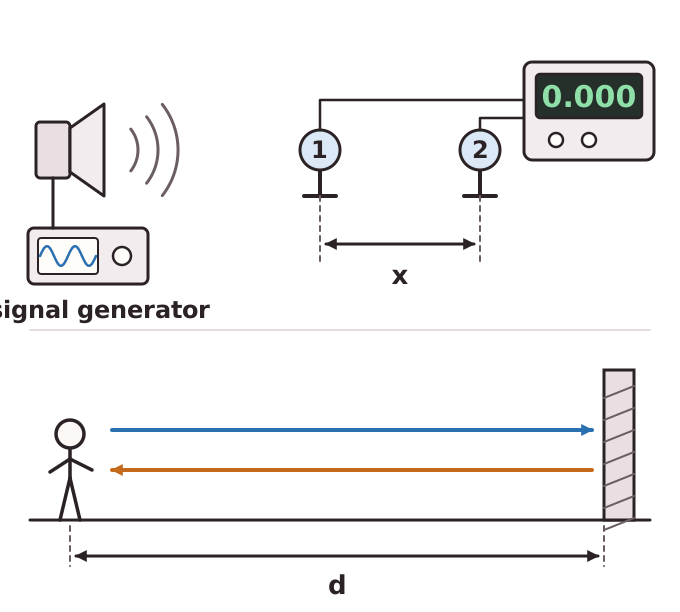
One simple way to measure the speed of sound is with two microphones. Place them a measured distance apart along a line from a loudspeaker, and connect both to a timer (or an oscilloscope). The first microphone starts the timer and the second stops it. Divide the distance between the microphones by the time on the timer. Repeat the measurement and take a mean to make the result more reliable.
Another method uses an echo. Stand a measured distance from a large flat wall and make a short loud noise. The sound travels to the wall and back, so the distance it travels is double the distance to the wall.
Ripples on water can be studied in a ripple tank. A vibrating dipper makes ripples, and a lamp above the tank casts their shadows onto a screen. A stroboscope can make the ripples look still, so their frequency can be matched to the flashing rate of the strobe. Measure the distance across several wavefronts on the screen and divide by the number of waves to find the wavelength. The speed is then v = f × λ.
You can also use v = x ÷ t to calculate a distance or a depth. If a pulse reflects back from a surface, the time you measure is for the there-and-back (return) journey, so distance = speed × time ÷ 2. For example, a shout echoes back from a wall after 1.0 s. The one-way time is 0.5 s, so the wall is 330 m/s × 0.5 s = 165 m away. A sonar pulse in sea water travels at about 1500 m/s.