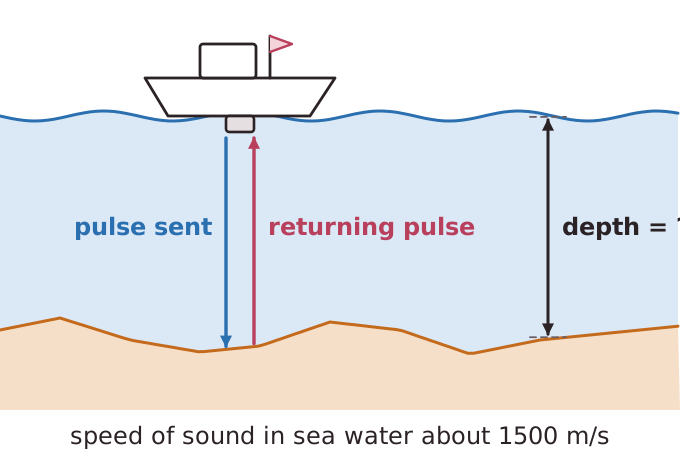
Many instruments find a distance by timing a wave. A pulse of sound or radio waves is sent out, hits a surface and reflects back as an echo. The device measures the time between sending the pulse and receiving the echo. The wave has gone to the surface and back, so it has travelled the distance twice.
Use the wave equation v = x ÷ t, rearranged to x = v × t. Here x is the total distance travelled in metres, v is the wave speed in m/s and t is the time in seconds. The depth or distance to the surface is half of this total, so divide by 2.
Worked example: a ship's sonar sends a pulse of sound down. Sound travels at about 1500 m/s in sea water and the echo returns after 0.40 s. Total distance = 1500 × 0.40 = 600 m. The sea floor is half of that, so the depth is 300 m.
The same idea works in air, where sound travels at about 340 m/s. An echo that returns from a wall after 0.10 s means a total distance of 34 m, so the wall is 17 m away. Always check the time is in seconds before you calculate, and never forget to halve.