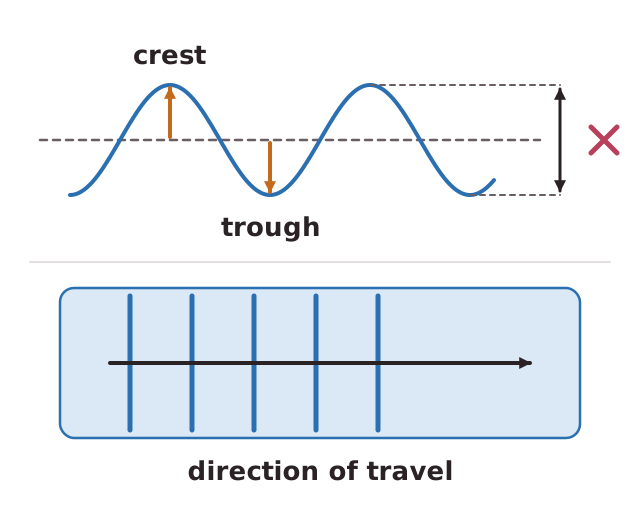
The amplitude of a wave is the maximum displacement of a point on the wave from its rest position. Measure it from the rest position up to a crest, or down to a trough, not from the trough to the crest. A larger amplitude means the wave carries more energy.
The period of a wave is the time taken for one complete wave to pass a point. It is measured in seconds. If 5 waves pass each second, one wave takes 0.2 s, so the period is 0.2 s. A higher frequency means a shorter period.
The wave velocity is the speed of the wave in a given direction. A wavefront is a line joining the crests of a wave, for example the straight lines you see when ripples spread out across water. The wave travels at right angles to its wavefronts.