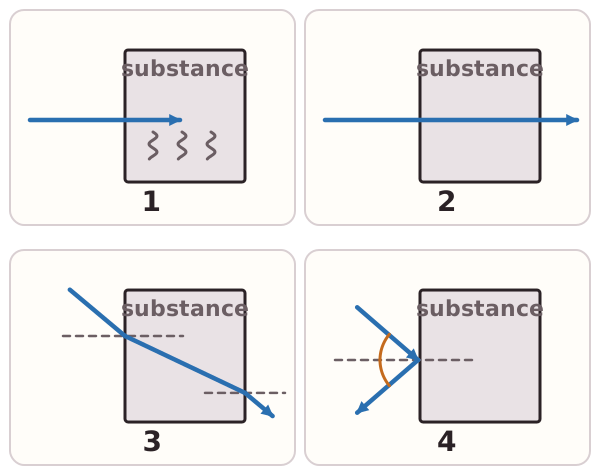
When a wave meets a substance it can be absorbed, transmitted, refracted or reflected, or a mixture of these. What happens depends on the substance and also on the wavelength of the wave. A material that transmits one kind of wave may absorb or reflect another.
- Glass transmits visible light but absorbs much ultraviolet radiation.
- The ozone layer absorbs most ultraviolet radiation from the Sun, so less of it reaches the surface of the Earth.
- The atmosphere transmits visible light, microwaves and many radio waves, but some radio waves are reflected by a layer high in the atmosphere, which lets them travel beyond the horizon.
- A metal sheet reflects microwaves, which is why the door of a microwave oven has a metal mesh.
- Soft tissue transmits most X-rays, but bone absorbs more of them.
Wavelength also changes how much a wave is refracted. In glass, shorter wavelengths are refracted more than longer wavelengths. This is why a prism splits white light into colours: violet light (short wavelength) is refracted more than red light (long wavelength).