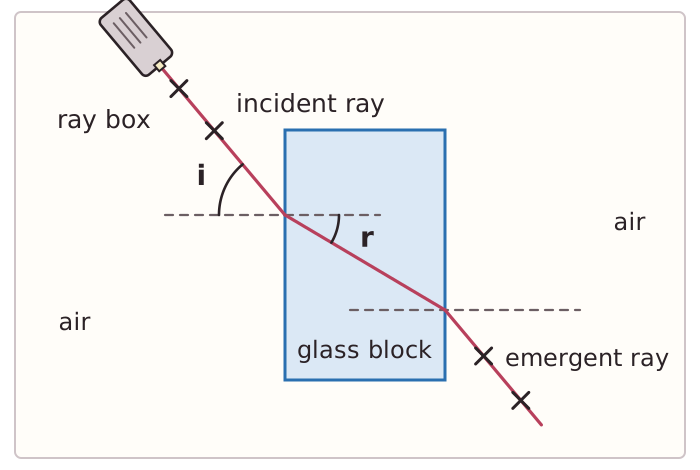
In this practical you investigate how light, an EM wave, is refracted when it passes into and out of a rectangular glass block. Place the block on a sheet of paper and draw around it. Use a ray box with a single slit (or a laser pointer, never shone towards anybody's eyes) to send a thin ray at the block. Mark two points on the incident ray and two on the ray that emerges from the far side. Remove the block, join the points, and join the entry and exit points to show the path of the ray inside the glass.
Draw the normal, a line at right angles to the surface where the ray enters. Use a protractor to measure the angle of incidence (between the incident ray and the normal) and the angle of refraction (between the ray in the glass and the normal). The angle of incidence is the independent variable and the angle of refraction is the dependent variable. Repeat for several different angles of incidence, using the same block each time, and plot a graph of the results.
When the ray enters the glass from air it bends towards the normal, so the angle of refraction is smaller than the angle of incidence. This happens because the light slows down in glass, as it interacts with the material. Leaving the block, it speeds up and bends away from the normal, so the emergent ray is parallel to the incident ray but shifted sideways. If the angle of incidence is zero, the ray travels along the normal and does not bend.