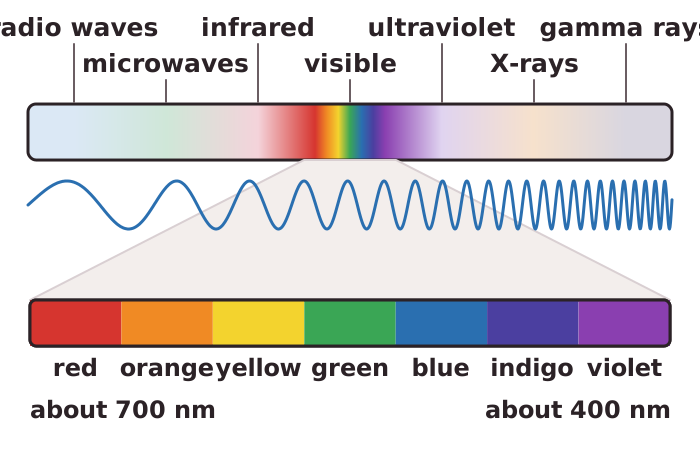
The electromagnetic spectrum is continuous. This means there are no gaps in it: the wavelengths and frequencies change smoothly from radio waves at one end to gamma rays at the other. The seven groups are a convenient way to label regions, and the boundaries between them are not sharp. One group merges gradually into the next.
Going from radio waves to gamma rays, the wavelength decreases and the frequency increases. So radio waves have the longest wavelength and the lowest frequency, and gamma rays have the shortest wavelength and the highest frequency. The groups can be listed in order of decreasing wavelength, which is also increasing frequency.
All EM waves travel at the same speed in a vacuum, 3 × 10⁸ m/s, and wave speed = frequency × wavelength. Since the speed is fixed, a wave with a higher frequency must have a shorter wavelength. For example, a radio wave of frequency 2 × 10⁸ Hz has wavelength 3 × 10⁸ ÷ 2 × 108 = 1.5 m.