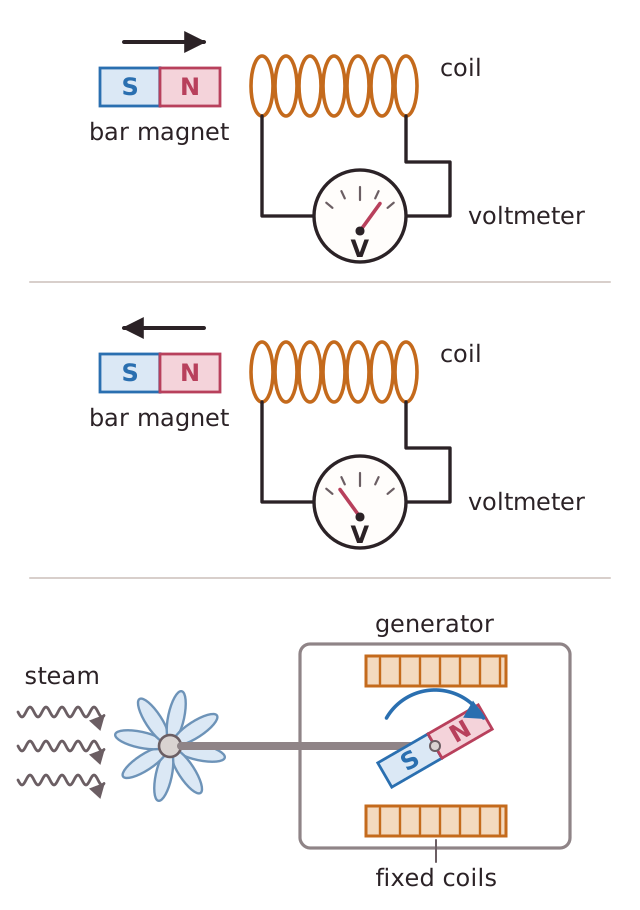
When a conductor moves relative to a magnetic field, a potential difference is induced across its ends. This is electromagnetic induction. If the conductor is part of a complete circuit, the induced potential difference drives a current round it. What matters is relative movement: it makes no difference whether the magnet moves and the wire is still, or the wire moves and the magnet is still. The conductor must cut through the magnetic field lines.
In the laboratory, connect a coil of wire to a sensitive voltmeter. Push a bar magnet into the coil and the meter deflects. Pull it out and the meter deflects the opposite way. Hold the magnet still, inside or outside the coil, and the reading is zero because there is no relative movement. A larger induced potential difference comes from moving the magnet faster, using a stronger magnet, or using a coil with more turns of wire.
Power stations use the same idea on a large scale. A turbine, turned by steam, wind or flowing water, spins a magnet (usually an electromagnet) inside fixed coils of wire. The rotation gives continuous relative movement, so the coils keep cutting the magnetic field and a potential difference is induced all the time. The generators then supply energy to the national grid.