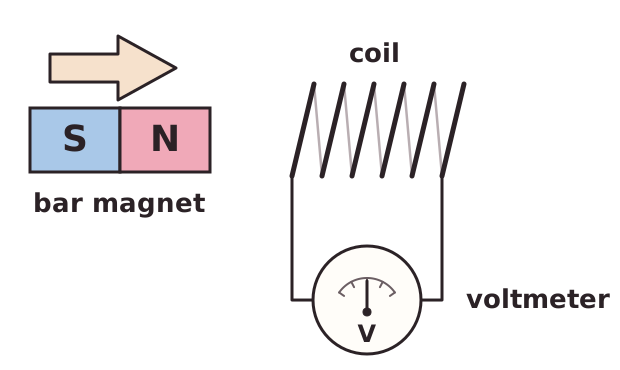
When a magnet moves relative to a coil of wire, or a wire cuts through a magnetic field, a potential difference is induced across the conductor. This is called electromagnetic induction. If the conductor is part of a complete circuit, the induced potential difference makes a current flow. Nothing is induced if the magnet and the coil are not moving relative to each other.
Three things change the size of the induced potential difference. Moving the magnet or the coil faster gives a larger induced potential difference, so the speed of movement matters. Using a stronger magnet gives a larger one. Using a coil with more turns of wire also gives a larger one.
The direction of the induced potential difference depends on the direction of the movement and on which pole of the magnet is used. Pulling the magnet out instead of pushing it in reverses the direction, because the movement is in the opposite direction. Turning the magnet round, so the other pole goes in first, also reverses it.
The induced current produces its own magnetic field. This field opposes the change that caused it. So when a north pole is pushed towards a coil, the coil's field repels the magnet, and you have to do work to keep pushing.