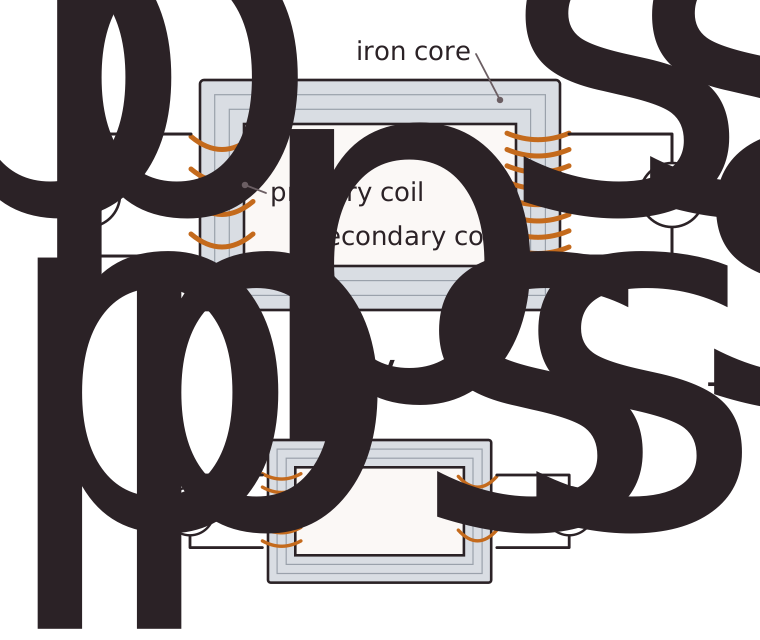
A transformer has a primary coil and a secondary coil wound on an iron core. The p.d. across each coil is in proportion to its number of turns, so the turns ratio equation is Vp ÷ Vs = Np ÷ Ns. Vp and Vs are the p.d.s across the primary and secondary coils in volts, and Np and Ns are the numbers of turns on those coils.
If the secondary coil has more turns than the primary, the output p.d. is greater than the input p.d. This is a step-up transformer. If the secondary has fewer turns, the output p.d. is smaller and it is a step-down transformer. Transformers only work with alternating p.d., because a changing current is needed to make a changing magnetic field in the core.
To use the equation, rearrange it so the unknown is on its own, then substitute. Example 1, finding a p.d.: a primary of 200 turns is connected to 12 V and the secondary has 600 turns. Vs = Vp × Ns ÷ Np = 12 × 600 ÷ 200 = 36 V.
Example 2, finding the turns: 230 V across the primary is stepped down to 23 V by a secondary of 50 turns. Np = Ns × Vp ÷ Vs = 50 × 230 ÷ 23 = 500 turns.