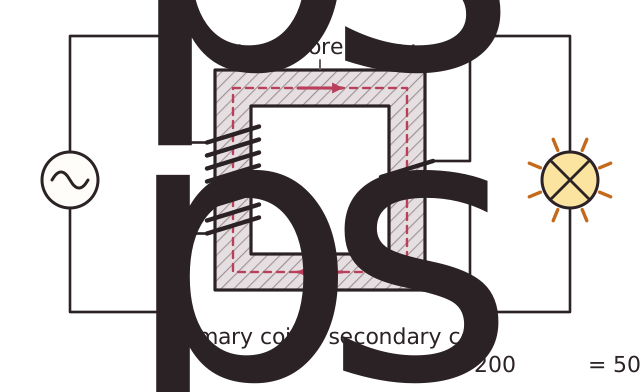
A basic transformer has a primary coil and a secondary coil wound on an iron core. Iron is used because it is easily magnetised. An alternating current in the primary coil produces a changing magnetic field. The iron core carries this changing field through the secondary coil, which induces an alternating potential difference across it. A transformer only works with alternating current, because direct current gives a constant field and nothing is induced.
The potential differences depend on the number of turns on each coil: Vp / Vs = np / ns. A step-up transformer has more turns on the secondary coil, so Vs is greater than Vp. A step-down transformer has fewer turns on the secondary coil, so Vs is less than Vp.
If a transformer is 100% efficient, the power output equals the power input: Vs × Is = Vp × Ip. Power is in watts (W), potential difference in volts (V) and current in amps (A). When the potential difference is stepped up, the current is stepped down by the same factor.
Example: a transformer has 200 turns on the primary coil and 50 turns on the secondary. The primary p.d. is 240 V, so Vs = 240 × 50 / 200 = 60 V. It is a step-down transformer. If the secondary current is 4 A, the output power is 60 × 4 = 240 W, so the primary current is 240 / 240 = 1 A.