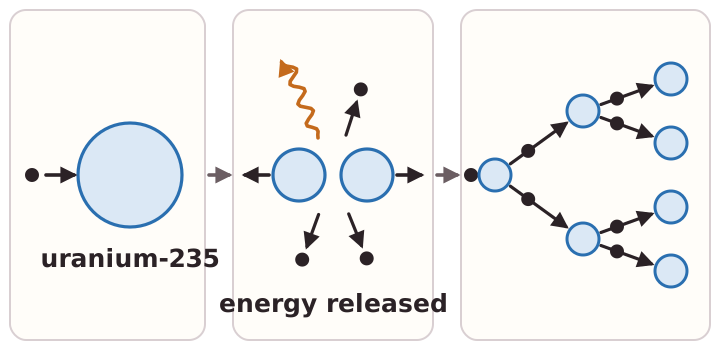
Nuclear fission is the splitting of a large, unstable nucleus, such as uranium or plutonium, into smaller nuclei. Spontaneous fission is rare. Usually the unstable nucleus must first absorb a neutron before it splits.
The nucleus splits into two smaller nuclei that are roughly equal in size. The reaction also emits two or three neutrons and gamma rays, and it releases energy. All of the fission products have kinetic energy, and this is the energy that is later used to heat water in a power station.
The neutrons that are emitted may be absorbed by other unstable nuclei, which then split and release more neutrons. This is a chain reaction. In a nuclear reactor the chain reaction is controlled so that the energy is released at a steady rate. In a nuclear weapon the chain reaction is uncontrolled, so a huge amount of energy is released very quickly and causes an explosion.