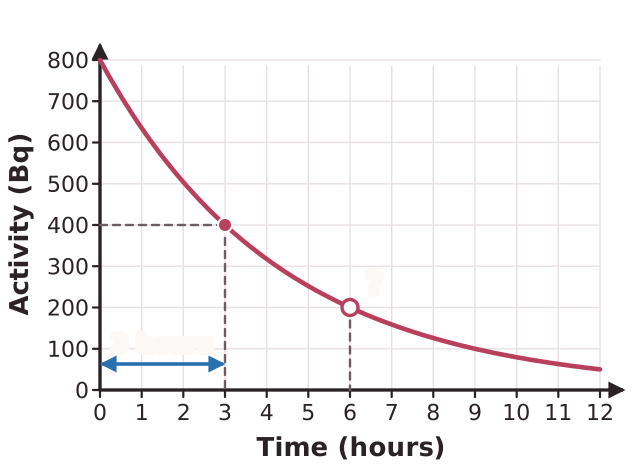
Radioactive decay is random. We cannot predict when a particular unstable nucleus will decay, and it is not affected by what we do to it. In a large sample, though, so many nuclei are decaying that the overall pattern is predictable.
The half-life of an isotope is the time it takes for the number of nuclei of the isotope in a sample to halve. It is also the time it takes for the count rate, or the activity, of a sample containing the isotope to fall to half its initial level. Every isotope has its own half-life.
Suppose a sample has an activity of 800 Bq and a half-life of 3 hours. After 3 hours the activity is 400 Bq, and after 6 hours it is 200 Bq. To find a half-life from data, pick a starting value, find the time when the value has fallen to half, and read off the time difference. For example, a count rate of 240 counts per second that falls to 120 after 10 minutes and to 60 after 20 minutes has gone through 2 half-lives, so its half-life is 10 minutes.
(Higher tier only) The net decline can be given as a ratio. After 1 half-life the activity is 1 : 2 of the start, after 2 half-lives it is 1 : 4, and after 3 half-lives it is 1 : 8, because each half-life halves the value again.