Some atomic nuclei are unstable. An unstable nucleus gives out radiation as it changes to become more stable. This is a random process called radioactive decay. The activity of a source is the rate at which its unstable nuclei decay, and it is measured in becquerel (Bq). A detector such as a Geiger-Muller tube records the count-rate, which is the number of decays it detects each second.
The radiation given out may be an alpha particle, a beta particle, a gamma ray or a neutron. An alpha particle is two protons and two neutrons, the same as a helium nucleus. A beta particle is a high speed electron that is ejected from the nucleus when a neutron turns into a proton. A gamma ray is electromagnetic radiation from the nucleus.
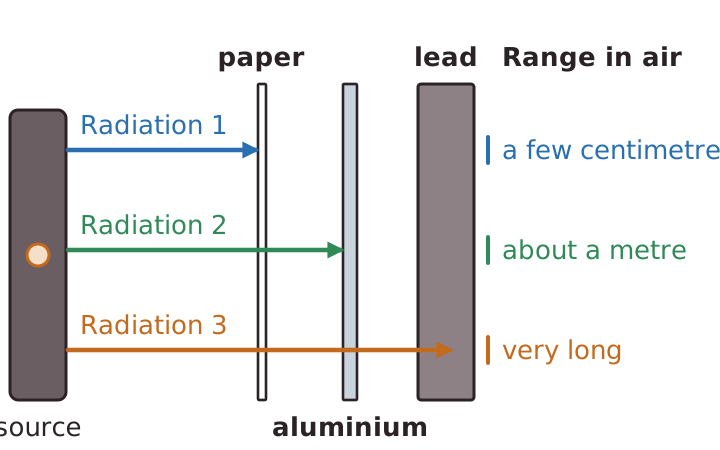
The three main types differ in how far they travel and how strongly they ionise. Alpha particles have a range in air of only a few centimetres, are stopped by a sheet of paper and are strongly ionising. Beta particles have a range in air of about a metre, are stopped by a thin sheet of aluminium and are moderately ionising. Gamma rays have a very long range in air, pass through paper and aluminium, need thick lead or concrete to absorb them, and are weakly ionising.
You may be asked to choose the best source for a job. A thickness gauge for aluminium foil needs a beta source, because the amount that gets through changes with the thickness. A source used inside the body for a scan needs gamma rays so that the radiation can get out to a detector.