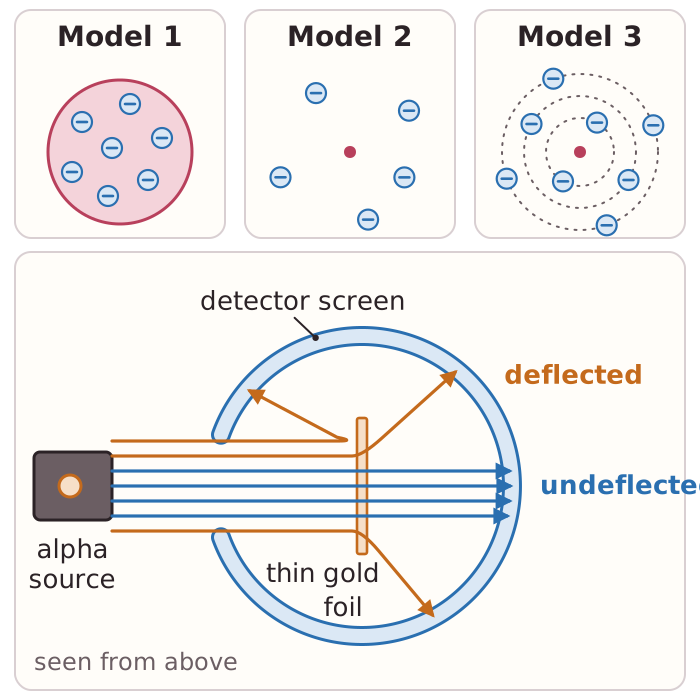
Scientific models change when new experimental evidence does not fit them. Before the discovery of the electron, atoms were thought to be tiny spheres that could not be divided. The discovery of the electron led to the plum pudding model: a ball of positive charge with negative electrons embedded in it.
In the alpha particle scattering experiment, positively charged alpha particles were fired at thin gold foil. Most went straight through, but a few were deflected through large angles. The plum pudding model could not explain this. The results showed that the mass of an atom is concentrated at the centre, in a nucleus, and that the nucleus is charged. The deflected alpha particles were repelled by the positive nucleus. The nuclear model replaced the plum pudding model.
Niels Bohr adapted the nuclear model by suggesting that electrons orbit the nucleus at specific distances. His calculations agreed with experimental observations.
Later experiments showed that the positive charge of any nucleus could be divided into a whole number of smaller particles, each with the same amount of charge. These were named protons. About 20 years after the nucleus became accepted, James Chadwick provided evidence for neutrons in the nucleus.