When a gradient or y-intercept gives a physical quantity, the best-fit and worst-fit lines give its uncertainty.Uncertainty in the gradient: the absolute uncertainty is the difference between the gradients of the best-fit and worst-fit lines.percentage uncertainty = (|best gradient − worst gradient| ÷ best gradient) × 100% Uncertainty in the y-intercept: the absolute uncertainty is the difference between the y-intercepts of the best-fit and worst-fit lines.uncertainty in intercept = |best intercept − worst intercept| Worked example: The best-fit line has gradient 2.0 and y-intercept 0.2. The worst-fit line has gradient 2.25 and y-intercept −0.55.
• Absolute uncertainty in gradient = 2.25 − 2.0 = 0.25
• Percentage uncertainty = 0.25 ÷ 2.0 × 100% = 12.5%
• Uncertainty in intercept = 0.2 − (−0.55) = 0.75, so the intercept is 0.2 ± 0.75. This range includes zero, so the data are consistent with the line passing through the origin.Using the gradient: if the gradient is multiplied or divided by other measured quantities, add their percentage uncertainties. For example, in a resistivity experiment, ρ = gradient × A. If the gradient has a 12.5% uncertainty and the cross-sectional area A has 1.5%, then ρ has a percentage uncertainty of 12.5% + 1.5% = 14%. A quantity equal to 1 ÷ gradient has the same percentage uncertainty as the gradient.If the x-axis does not start at zero, calculate each intercept using c = y − mx with a point on that line.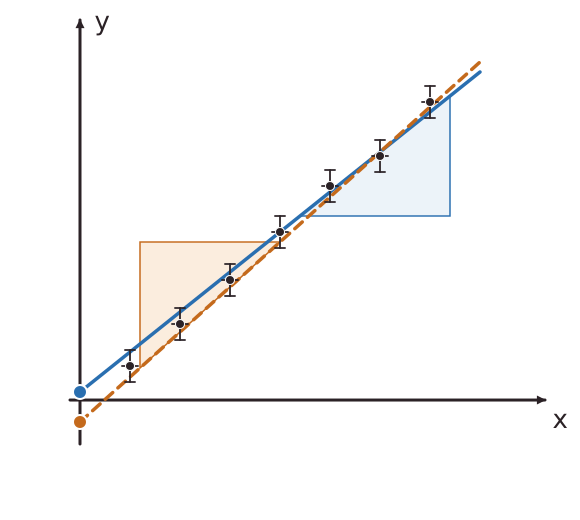
• Absolute uncertainty in gradient = 2.25 − 2.0 = 0.25
• Percentage uncertainty = 0.25 ÷ 2.0 × 100% = 12.5%
• Uncertainty in intercept = 0.2 − (−0.55) = 0.75, so the intercept is 0.2 ± 0.75. This range includes zero, so the data are consistent with the line passing through the origin.Using the gradient: if the gradient is multiplied or divided by other measured quantities, add their percentage uncertainties. For example, in a resistivity experiment, ρ = gradient × A. If the gradient has a 12.5% uncertainty and the cross-sectional area A has 1.5%, then ρ has a percentage uncertainty of 12.5% + 1.5% = 14%. A quantity equal to 1 ÷ gradient has the same percentage uncertainty as the gradient.If the x-axis does not start at zero, calculate each intercept using c = y − mx with a point on that line.