Each component resists the flow of charge carriers through it.Metals are made of a lattice of vibrating positive metal ions surrounded by delocalised electrons. When you apply a potential difference across the metal, electrons flow towards the positive end.
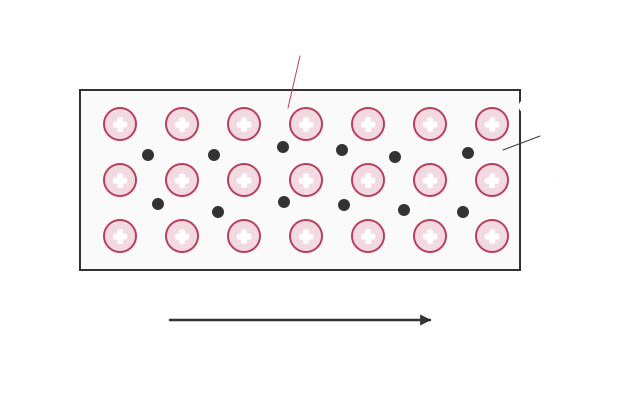
Resistance is the ratio of the potential difference across a component to the current through the component.Electrical components called resistors have known resistance. All components have resistance. It takes energy to push electrons through the component and the higher the resistance the more energy it takes.The unit of resistance is the ohm Ω.One ohm is defined as the resistance of a component when the p.d. of 1V produces a current of 1A.
Resistance
Read the text
Read the text and highlight anything you think is important. When you go on, the text is hidden and you answer from memory.
Specification: OCR Physics A (H156), AS-level, 4.2.3 Resistance. Topic: Electricity.
Key terms in this lesson
- displacement
- The distance an object has moved in a straight line from its starting point, in a particular direction.
- amplitude
- The maximum displacement of a particle or wave from its equilibrium position.
- intensity
- The radiant power passing through a surface per unit area.
More in Electricity
- Current and Drift Velocity
- Potential Difference
- Electromotive Force
- The Electron Gun
- Ohm's Law
- Temperature and Resistance
- IV Graphs
- Diodes
All 30 lessons in Electricity · All OCR AS-level Physics topics