Fixed resistors are designed to obey Ohm's law under normal changes of temperature when current flows. They are described as ohmic conductors. The resistor behaves in the same way regardless of the polarity.Most wires and metallic conductors are ohmic.Filament lamps do not obey Ohm's law and are non-ohmic conductors. They behave the same way regardless of polarity.As the potential difference increases, the current increases and more electrons flow through the wire every second.As the current increases there are more collisions per second with the positive metal ions so the electrons transfer more energy to the positive metal ions which vibrate more. As the temperature and vibrations increase there are more collisions so the resistance increases, so the current increases by less for each rise in p.d.The wire gets very hot so it glows.
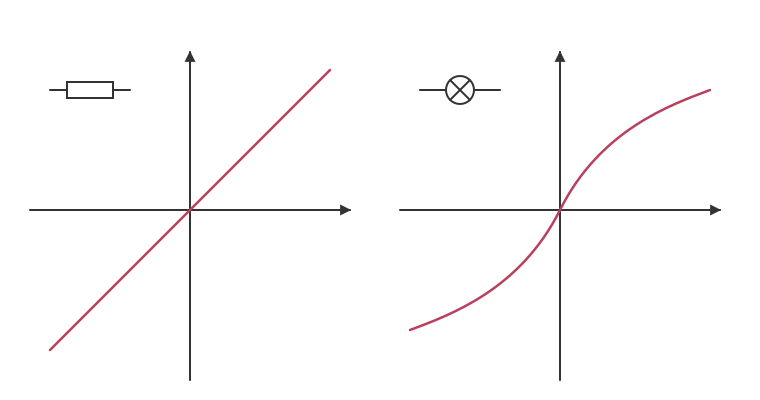
IV Graphs
Read the text
Read the text and highlight anything you think is important. When you go on, the text is hidden and you answer from memory.
Specification: OCR Physics A (H156), AS-level, 4.2.3 Resistance. Topic: Electricity.
Key terms in this lesson
- energy
- The capacity of a system to do work.
- progressive wave
- An oscillation that travels through a medium or space, transferring energy from one place to another without transferring matter.
- amplitude
- The maximum displacement of a particle or wave from its equilibrium position.
- frequency
- The number of complete oscillations or wavelengths passing a given point per unit time.
- intensity
- The radiant power passing through a surface per unit area.
More in Electricity
- The Electron Gun
- Resistance
- Ohm's Law
- Temperature and Resistance
- Diodes
- Resistivity
- Temperature and Number Density
- The Thermistor
All 30 lessons in Electricity · All OCR AS-level Physics topics