I = A n e vwhere I = current, n = number density, v = drift velocity of electrons, A = cross-sectional area of the conductor and e = charge on an electron 1.6 × 10⁻¹⁹C.
The narrower the cross-sectional area of the wire the greater the drift velocity must be for the same current.Current and Drift Velocity
Electrons are moving around randomly in the metallic lattice at very high speed. When a potential difference is applied all the free electrons drift slowly towards the positive terminal at once.
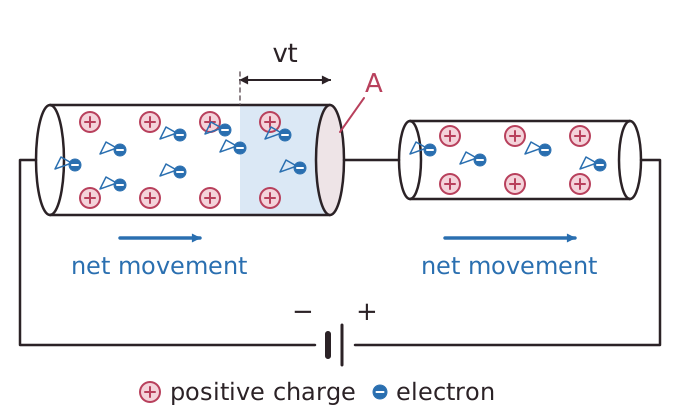
A formula for electric current in a metal is:
Read the text
Read the text and highlight anything you think is important. When you go on, the text is hidden and you answer from memory.
Specification: OCR Physics A (H156), AS-level, 4.1.2 Mean drift velocity. Topic: Electricity.
Key terms in this lesson
- energy
- The capacity of a system to do work.
- kinetic energy
- The energy an object possesses due to its motion.
- power
- The rate at which work is done, or the rate of transfer of energy.
- progressive wave
- An oscillation that travels through a medium or space, transferring energy from one place to another without transferring matter.
- amplitude
- The maximum displacement of a particle or wave from its equilibrium position.
More in Electricity
- Millikan's Oil Drop Experiment
- The Flow of Charge in Metals and Electrolytes
- Kirchhoff's First Law and Conservation of Charge
- Conductors and Semi-Conductors
- Potential Difference
- Electromotive Force
- The Electron Gun
- Resistance
All 30 lessons in Electricity · All OCR AS-level Physics topics