The length and diameter of a wire about 1 metre long are measured.The diameter is measured at 10 different places with a micrometer screw gauge and the mean diameter is calculated.This is used to calculate the cross-sectional area of the wire using A = π(d/2)2.The length of the wire is measured with a metre rule.The wire is passed over a pulley and attached to a slotted mass holder. Using increasing force as the independent variable, slotted masses are added and the corresponding extension (the dependent variable) is measured from the movement of a marker on the wire against a fixed rule.Plot stress against strain.Gradient = E (Young modulus).
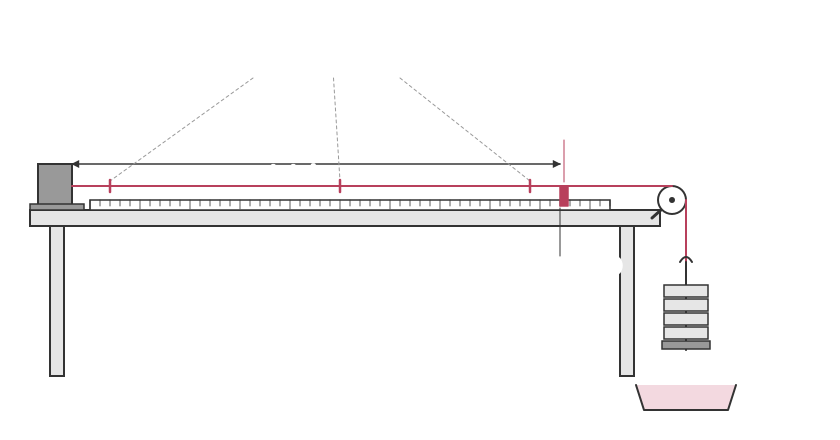
Experiment to Measure the Young Modulus
Read the text
Read the text and highlight anything you think is important. When you go on, the text is hidden and you answer from memory.
Specification: Edexcel Physics (8PH0), AS-level, Topic 4: Materials, statements 54 and 57. Topic: Solid Materials.
Key terms in this lesson
- stress
- The force applied to a material per unit cross-sectional area, measured in pascals.
- strain
- The ratio of the extension of a material to its original length; it has no units.
- young modulus
- The ratio of stress to strain for a material undergoing elastic deformation, a measure of its stiffness.
More in Solid Materials
- Stress
- Strain
- The Young Modulus
- Stress-Strain Graph Metal Wire
- Properties of Materials
- Exam Style Question - 1
All 14 lessons in Solid Materials · All Edexcel AS-level Physics topics