Engineers use precise words to describe how materials behave under a force.Stiff: needs a large force for a small extension. A stiff material has a high Young modulus; steel is much stiffer than rubber.Strong: needs a large stress to break it. Strength is measured by the ultimate tensile stress, the maximum stress the material can withstand.Elastic: returns to its original shape and size when the deforming force is removed.Plastic: stays permanently deformed when the force is removed.Ductile: can be drawn out into wires, because it undergoes a large plastic deformation before breaking (copper).Malleable: can be hammered or pressed into thin sheets without breaking (gold, lead).Brittle: breaks with little or no plastic deformation, often shattering suddenly (glass, cast iron, ceramics).Hard: resists scratching and indentation of its surface (diamond).Tough: absorbs a lot of energy before it breaks, so cracks do not spread easily.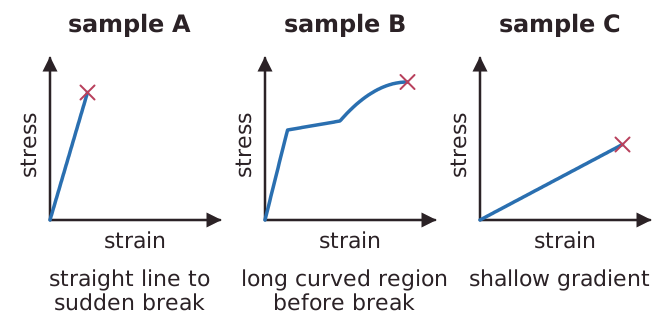 A material can have several of these properties at once. Glass is stiff and hard but brittle. Copper is ductile and malleable. A climbing rope must be strong and tough, but not too stiff, so it can absorb the energy of a fall.Example: a sample's stress-strain graph is a straight line that ends suddenly at 50 MPa with no curved plastic region. It shows no plastic deformation before breaking, so the material is brittle.