 BRAINCAKE
Stopping Potential
When light with a frequency above the threshold frequency is shone on the cathode photoelectrons will be emitted and will travel across the gap to the anode and a current will be registered on the ammeter.
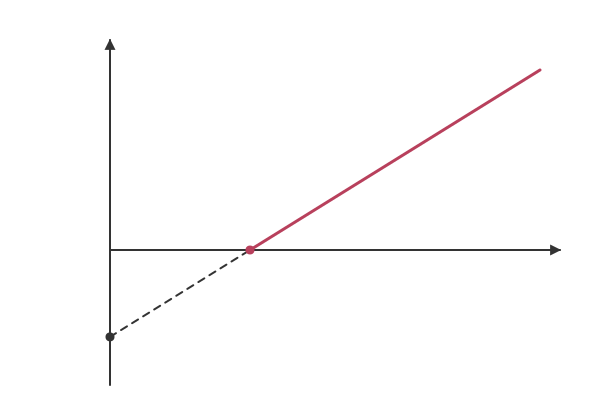
The potential difference across the photoelectric cell is increased slowly until the anode is sufficiently negative to repel the photoelectrons and no current will be registered.
Sign in free to see the rest of this lesson, the R.E.C.I.P.E. recall steps and the quiz
BrainCake is free. Make an account in seconds and pick up where this page stops.
Key terms in this lesson
- threshold frequency
- The minimum frequency of electromagnetic radiation that will cause photoelectric emission from a given metal surface.
More in Quantum Physics
- The Energy of a Photon
- Electrons as Waves
- Photoelectric Effect
- The Equation for the Photoelectric Effect
- Electron Diffraction
- DeBroglie Wavelength
- Electron Microscopes
- Electron Energy Levels
All 21 lessons in Quantum Physics · All Edexcel AS-level Physics topics