If ultraviolet light is directed at a negatively charged zinc plate the plate loses its charge.Electrons absorb the energy from the incident light and leave the metal as photoelectrons.1. There is a minimum amount of energy that an electron needs to escape from the surface of the metal. This is called the work function and has the symbol φ.2. If the frequency of the light is below the threshold frequency, no photoelectrons are emitted however much the intensity is increased.If light was behaving as a wave, since the intensity of the incident light is related to its energy, any wavelength of sufficient intensity would release photoelectrons.Absorbing light energy over a period of time does not cause photoelectric emission if the frequency is below the threshold frequency.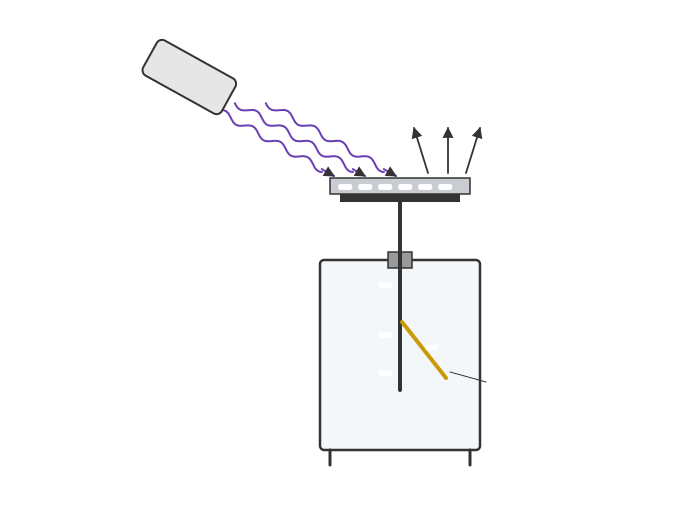
ExplanationLight travels as photons with photon energy E = hfWhen a photon encounters an electron, the electron absorbs all the photon energy.If the frequency of the photon is greater than the threshold frequency the electron will gain more energy than the work function i.e. hf > φ and will escape from the surface of the metal. If the intensity is increased, more photons per second are incident on the surface and more photoelectrons per second are released.If the energy of a photon is below the work function the electron will transfer the energy to the metal (the lattice) as a whole, which is heated, and no photoelectrons are observed.
ExplanationLight travels as photons with photon energy E = hfWhen a photon encounters an electron, the electron absorbs all the photon energy.If the frequency of the photon is greater than the threshold frequency the electron will gain more energy than the work function i.e. hf > φ and will escape from the surface of the metal. If the intensity is increased, more photons per second are incident on the surface and more photoelectrons per second are released.If the energy of a photon is below the work function the electron will transfer the energy to the metal (the lattice) as a whole, which is heated, and no photoelectrons are observed.