The strongest evidence that electrons can behave as waves comes from electron diffraction.In the laboratory, an electron gun in an evacuated glass tube produces a beam of electrons: a heated filament releases electrons by thermionic emission and they are accelerated towards an anode by a potential difference of a few kilovolts. The beam then passes through a very thin film of graphite and hits a fluorescent screen.
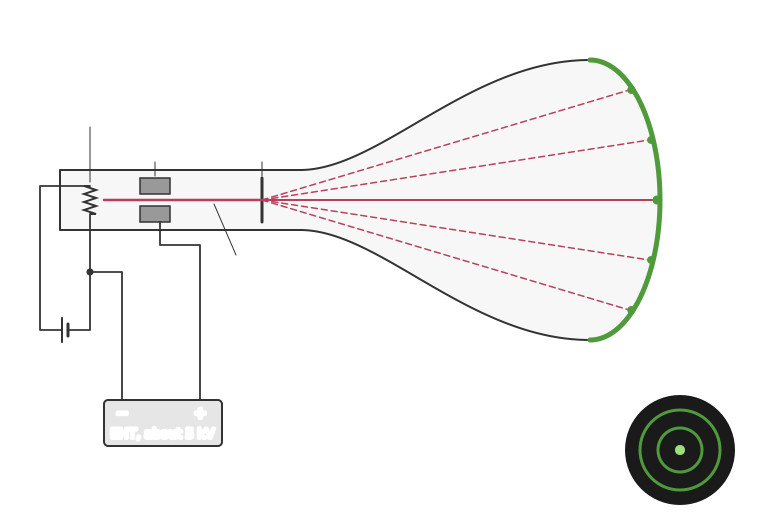
Instead of a single bright spot, a pattern of concentric rings appears on the screen. Rings like these can only be explained by diffraction and interference, which are wave properties. The regularly spaced carbon atoms in graphite act like a diffraction grating, because the spacing between them (about 10-10 m) is similar to the wavelength of the electrons.The pattern is made of rings, rather than spots, because the graphite is made of many tiny crystals lying in random orientations, so the electrons are diffracted in every direction around the beam.If the accelerating potential difference is increased, the electrons move faster and have a shorter wavelength. They are diffracted through smaller angles, so the rings become smaller. Lowering the voltage makes the rings larger.Diffraction is only noticeable when the wavelength is comparable to the size of the gap or the spacing of the obstacles. This is why electron diffraction is seen with crystals, but not with everyday gaps such as a doorway.Electron diffraction was first observed in 1927, by Davisson and Germer and separately by G. P. Thomson, confirming de Broglie's prediction that particles have a wavelength.
Electron Diffraction
Read the text
Read the text and highlight anything you think is important. When you go on, the text is hidden and you answer from memory.
Specification: Edexcel Physics (8PH0), AS-level, Topic 5: Waves and Particle Nature of Light. Topic: Quantum Physics.
Key terms in this lesson
- thermionic emission
- The emission of electrons from the surface of a heated metal filament.
More in Quantum Physics
- Electrons as Waves
- Photoelectric Effect
- The Equation for the Photoelectric Effect
- Stopping Potential
- DeBroglie Wavelength
- Electron Microscopes
- Electron Energy Levels
- Excitation and De-excitation
All 21 lessons in Quantum Physics · All Edexcel AS-level Physics topics