 BRAINCAKE
Plane Polarisation
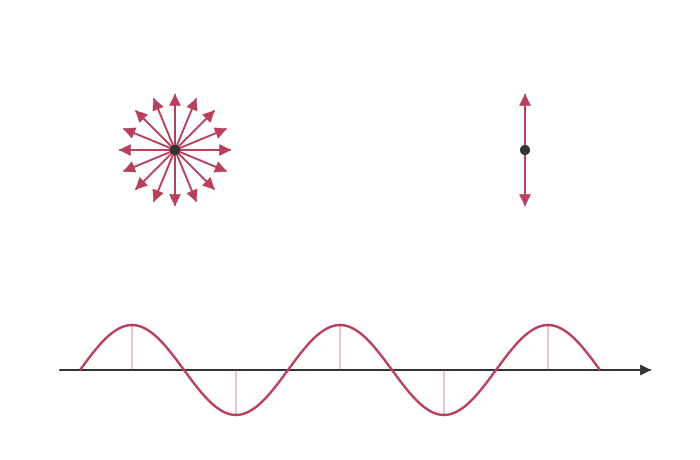
Light is a transverse wave: the oscillations (of the electric and magnetic fields) are perpendicular to the direction in which the wave travels and transfers energy.
In unpolarised light, such as light from the Sun, a filament lamp or a candle, the oscillations occur in many different planes, all perpendicular to the direction of travel.
In plane polarised light the oscillations are confined to one plane only, a plane that contains the direction of travel of the wave. For light, the plane of polarisation is usually described by the direction of the electric field oscillation.
Sign in free to see the rest of this lesson, the R.E.C.I.P.E. recall steps and the quiz
BrainCake is free. Make an account in seconds and pick up where this page stops.
More in Optics
- The Power of Twin Lenses
- Forming an Image
- Image Calculations
- Magnification
- Polarising Filters
- Polarisation by Reflection and Refraction
- Exam-style Question 1
- Exam-style Question 2
All 21 lessons in Optics · All Edexcel AS-level Physics topics