A polarising filter (such as Polaroid) contains long-chain molecules lined up in one direction. It only lets through oscillations in one plane, along its transmission axis, and absorbs the rest.When unpolarised light passes through a polarising filter (the polariser), the light that emerges is plane polarised. Its intensity is reduced to about half of the original, because the oscillations at right angles to the transmission axis are absorbed.A second filter, called the analyser, can then be used to test the polarised light.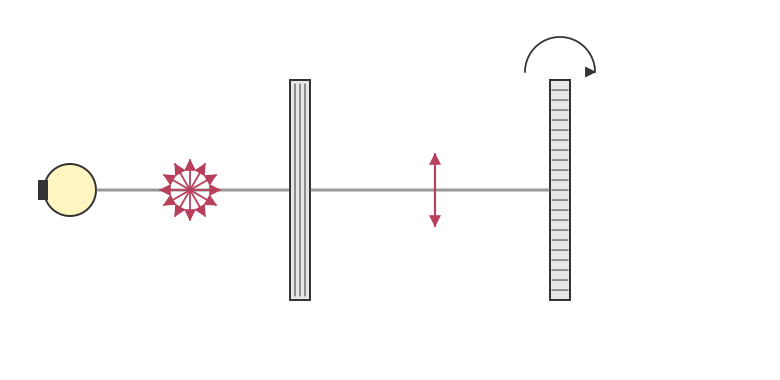
- If the axes are at 90° (the filters are crossed), no light passes through.
- As the analyser is rotated through 360°, the transmitted intensity passes through two maxima (at 0° and 180°) and two minima of zero (at 90° and 270°).A single filter rotated in front of unpolarised light gives no change in brightness, because the incoming light has oscillations in all planes. If the brightness does change as a filter is rotated, the light was already polarised.The same effect can be shown with microwaves and a metal grille. The grille absorbs the microwaves when its rods are parallel to the electric field oscillations and transmits them when the rods are perpendicular.Stress analysis: when a transparent plastic model is placed between crossed polarising filters and viewed in white light, coloured fringes appear. The fringes are closest together where the stress is greatest, so engineers can find weak points in a design.