Stars behave approximately as black bodies: ideal objects that absorb all the radiation falling on them and emit a continuous spectrum of electromagnetic radiation that depends only on their temperature.A graph of intensity against wavelength for a black body has a characteristic shape. It rises steeply to a peak at a wavelength λmax, then falls away more gradually at longer wavelengths.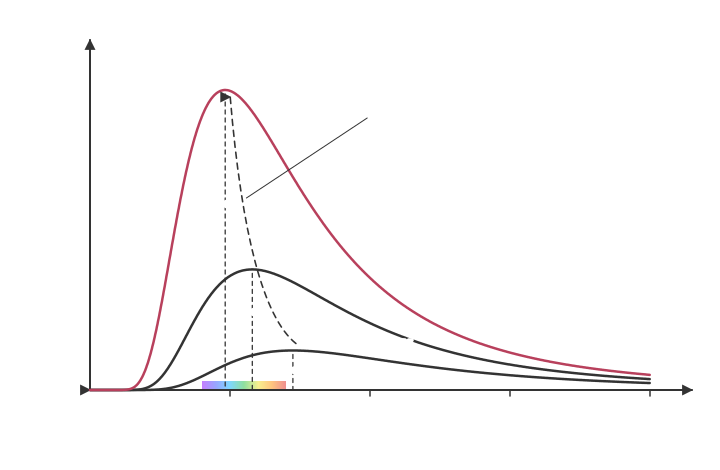
λmax ∝ 1/T so λmaxT = constant The constant is 2.9 × 10⁻³ m K, and T must be in kelvin.This explains the colours of stars. Hot stars, with a peak in the blue or ultraviolet, look blue-white. Cool stars, with a peak in the red or infrared, look red.Worked example: the Sun's spectrum peaks at about 500 nm. Estimate its surface temperature.
T = 2.9 × 10⁻³ / λmax = 2.9 × 10⁻³ / 5.0 × 10−7 = 5800 KWien's law can also compare stars without using the constant: if star A's peak wavelength is half that of star B, star A's surface temperature is twice that of star B.
T = 2.9 × 10⁻³ / λmax = 2.9 × 10⁻³ / 5.0 × 10−7 = 5800 KWien's law can also compare stars without using the constant: if star A's peak wavelength is half that of star B, star A's surface temperature is twice that of star B.