 BRAINCAKE
Stellar Parallax
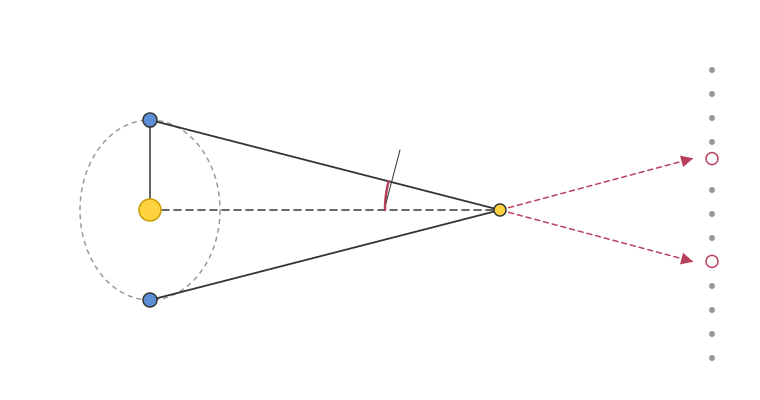
Stellar parallax is the apparent shift in the position of a nearby star against the background of much more distant stars, caused by the Earth's motion around the Sun.
The position of the star is measured, and then measured again six months later, when the Earth is on the opposite side of its orbit. The baseline between the two observations is 2 AU. The parallax angle p is half the angle through which the star appears to move, so it is the angle subtended at the star by a baseline of 1 AU (the Earth-Sun distance).
Sign in free to see the rest of this lesson, the R.E.C.I.P.E. recall steps and the quiz
BrainCake is free. Make an account in seconds and pick up where this page stops.
More in Astrophysics and Cosmology
- Wien's Displacement Law
- Stefan's Law
- Estimating the Radius of a Star
- The Astronomical Unit, Light Year and Parsec
- The Cosmological Principle
- The Doppler Effect and Red Shift
- Hubble's Law
- The Big Bang Theory
All 24 lessons in Astrophysics and Cosmology · All OCR A-level Physics topics