Emission line spectrum: a hot gas at low pressure emits light at only certain wavelengths. Seen through a spectrometer, it is a series of bright coloured lines on a dark background. Each line is produced when electrons in the atoms drop from a higher energy level to a lower one, emitting photons of energy ΔE = hc/λ.Continuous spectrum: a hot, dense object, such as a lamp filament or the dense interior of a star, emits all wavelengths over a range.Absorption line spectrum: when white light (a continuous spectrum) passes through a cooler gas, the gas atoms absorb photons whose energies exactly match the difference between two of their energy levels, exciting electrons to higher levels. These wavelengths are missing from the transmitted light, giving dark lines on a continuous spectrum. The absorbed energy is re-emitted in all directions, so few photons continue in the original direction.For a given element, the dark absorption lines are at exactly the same wavelengths as the bright emission lines, because both come from the same energy level differences.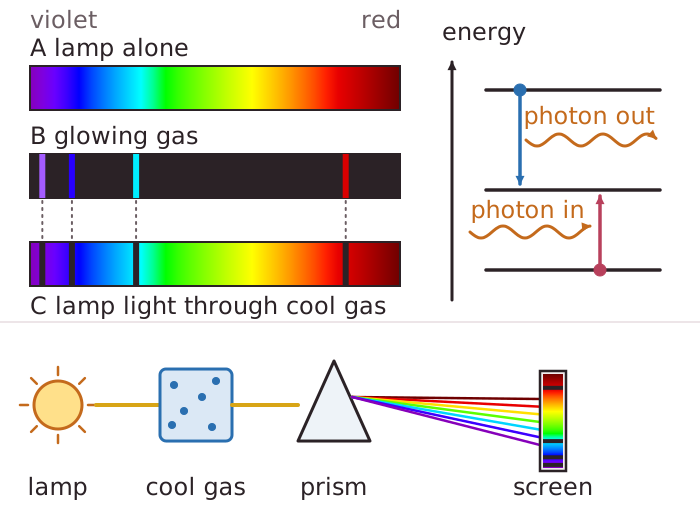 Each element has its own unique set of energy levels, so its line spectrum is like a fingerprint. Light from a star passes through the cooler gases of the star's outer atmosphere, so a star's spectrum is an absorption line spectrum. By matching the dark lines with the known spectra of elements, astronomers identify the elements present in the star. Helium was first discovered in this way, from lines in the spectrum of the Sun.