Distances in astronomy are so large that metres are inconvenient, so three larger units are used.Astronomical unit (AU): the mean distance from the Earth to the Sun.1 AU = 1.50 × 10¹¹ m It is convenient for distances within the Solar System. For example, Jupiter is about 5.2 AU from the Sun.Light year (ly): the distance travelled by light in a vacuum in one year.1 ly = 3.00 × 108 × (365 × 24 × 3600) = 9.46 × 10¹⁵ m When we look at a star 100 ly away, we see light that left it 100 years ago.Parsec (pc): the distance at which a baseline of 1 AU subtends an angle of 1 arcsecond (1/3600 of a degree).1 pc = 3.1 × 10¹⁶ m ≈ 3.26 ly Parsecs, kiloparsecs (kpc) and megaparsecs (Mpc) are used for distances to stars and galaxies. How the parsec is used to measure distances is covered in the lesson on stellar parallax.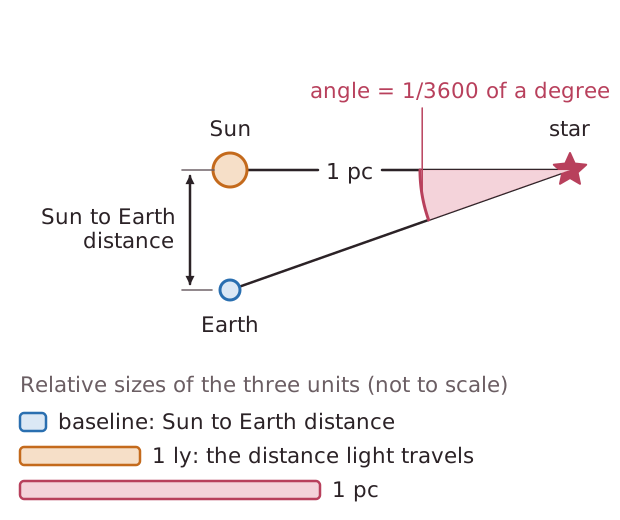 Worked example: the nearest star, Proxima Centauri, is 4.24 ly away. Express this distance in metres and in parsecs.
d = 4.24 × 9.46 × 1015 = 4.01 × 10¹⁶ m
d = 4.01 × 10¹⁶ / 3.1 × 1016 = 1.3 pc
Worked example: the nearest star, Proxima Centauri, is 4.24 ly away. Express this distance in metres and in parsecs.d = 4.24 × 9.46 × 1015 = 4.01 × 10¹⁶ m
d = 4.01 × 10¹⁶ / 3.1 × 1016 = 1.3 pc