 BRAINCAKE
Energy Levels in Atoms
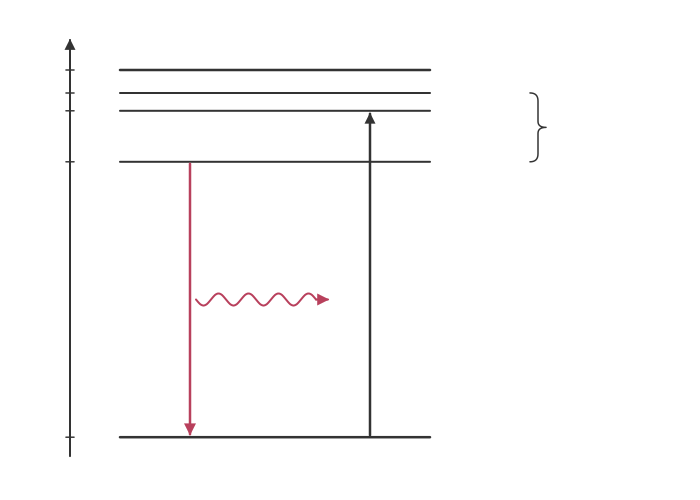
Electrons in an isolated atom (for example, an atom in a gas) can only exist in certain discrete energy levels. An electron cannot have an energy between these levels.
The energies of the levels are negative. This is because zero energy is defined as the energy of an electron that has just been freed from the atom. Energy must be supplied to free a bound electron, so a bound electron has less than zero energy. The lowest, most negative level is the ground state. Higher levels are excited states. Energies are often given in electronvolts (1 eV = 1.60 × 10⁻¹⁹ J).
Sign in free to see the rest of this lesson, the R.E.C.I.P.E. recall steps and the quiz
BrainCake is free. Make an account in seconds and pick up where this page stops.
More in Astrophysics and Cosmology
- Evolution of a Massive Star
- White Dwarfs and the Chandrasekhar Limit
- Neutron Stars and Black Holes
- The Hertzsprung-Russell Diagram
- Emission and Absorption Line Spectra
- Using Diffraction Gratings to Analyse Starlight
- Wien's Displacement Law
- Stefan's Law
All 24 lessons in Astrophysics and Cosmology · All OCR A-level Physics topics