The wavelength at which a black body emits the greatest intensity is called the peak wavelength, λmax. Wien's law links it to the absolute temperature:λmaxT = 2.898 × 10⁻³ m K So λmax is inversely proportional to T. Double the temperature and the peak wavelength halves. This is the shift of the peak to shorter wavelengths seen on black-body curves.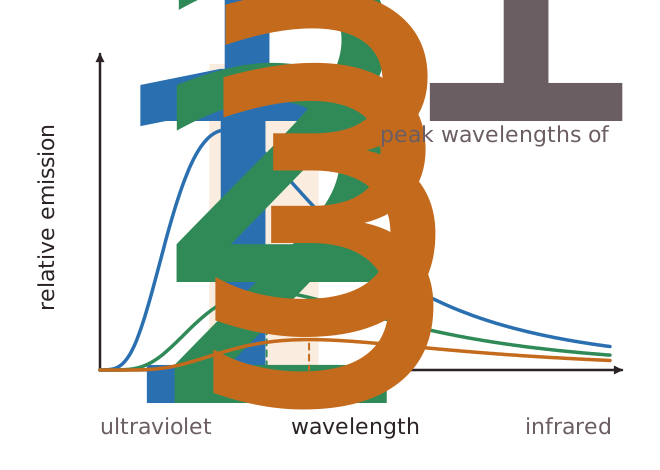 To use the law, λmax must be in metres and T in kelvin. Remember 1 nm = 10−9 m.Astronomers measure the intensity of a star's light across a range of wavelengths, find the wavelength of the peak, and use Wien's law to calculate the star's surface temperature. Because only the position of the peak matters, the star's distance does not need to be known.Worked example: the Sun's spectrum peaks at about 500 nm. Estimate its surface temperature.
T = 2.898 × 10⁻³ ÷ 5.00 × 10−7 = 5.8 × 10³ K Worked example 2: a red star has T = 3000 K. Where is its peak?λmax = 2.898 × 10⁻³ ÷ 3000 = 9.7 × 10⁻⁷ m = 970 nm This is in the infrared, beyond the red end of the visible spectrum, which is why such stars look red.
To use the law, λmax must be in metres and T in kelvin. Remember 1 nm = 10−9 m.Astronomers measure the intensity of a star's light across a range of wavelengths, find the wavelength of the peak, and use Wien's law to calculate the star's surface temperature. Because only the position of the peak matters, the star's distance does not need to be known.Worked example: the Sun's spectrum peaks at about 500 nm. Estimate its surface temperature.