A black body is an idealised object that absorbs all the electromagnetic radiation that falls on it, at every wavelength. It is also the best possible emitter: when hot it emits a continuous spectrum of radiation called black-body radiation.The shape of this spectrum depends only on the temperature of the body, not on what it is made of. Stars are a good approximation to black bodies, so their spectra can be used to find their surface temperatures.The graph shows intensity (power emitted per unit wavelength) against wavelength for black bodies at three temperatures.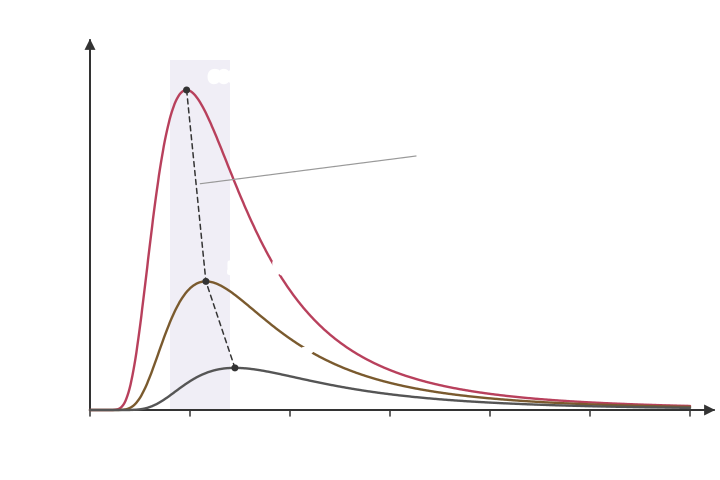
• each curve rises to a peak, then falls away more slowly at long wavelengths
• as temperature increases, the peak moves to shorter wavelengths
• as temperature increases, the intensity at every wavelength increases, so the peak is higher
• the area under a curve represents the total power emitted, which increases very rapidly with temperatureThis explains the colours of stars. A cool star (about 3000 K) peaks in the infrared and looks red. The Sun (about 5800 K) peaks in the visible. A hot star (about 10 000 K or more) peaks in the ultraviolet and looks blue-white.The next two lessons put numbers on these features: the Stefan-Boltzmann law for the total power and Wien's law for the peak wavelength.