A star radiates its power equally in all directions. At a distance d from the star, that power L is spread over the surface of a sphere of area 4πd2. The intensity received is thereforeI = L ÷ 4πd2 This is an inverse square law: I is proportional to 1/d2. Doubling the distance spreads the same power over four times the area, so the intensity falls to a quarter. Tripling the distance reduces it to a ninth.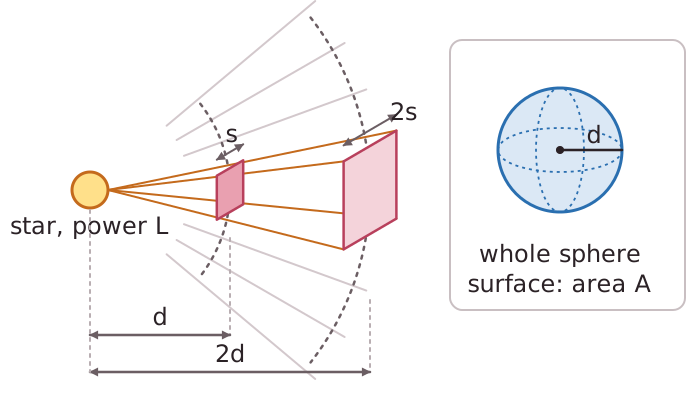 The law assumes that the radiation spreads out evenly in all directions and that none is absorbed on the way (for example by dust or Earth's atmosphere).It can be used in three ways: find I from L and d, find L from measured I and d, or find d from L and I.Worked example: the Sun has L = 3.9 × 1026 W and is 1.5 × 10¹¹ m from Earth. Find the intensity at Earth.
I = 3.9 × 1026 ÷ (4π × (1.5 × 1011)2) = 3.9 × 1026 ÷ 2.83 × 1023 = 1.4 × 10³ W m−2 Ratio method: for the same star, I1d12 = I2d22. Mars is about 1.5 times further from the Sun than Earth, so it receives 1/1.52, about 0.44 of the intensity at Earth.
The law assumes that the radiation spreads out evenly in all directions and that none is absorbed on the way (for example by dust or Earth's atmosphere).It can be used in three ways: find I from L and d, find L from measured I and d, or find d from L and I.Worked example: the Sun has L = 3.9 × 1026 W and is 1.5 × 10¹¹ m from Earth. Find the intensity at Earth.