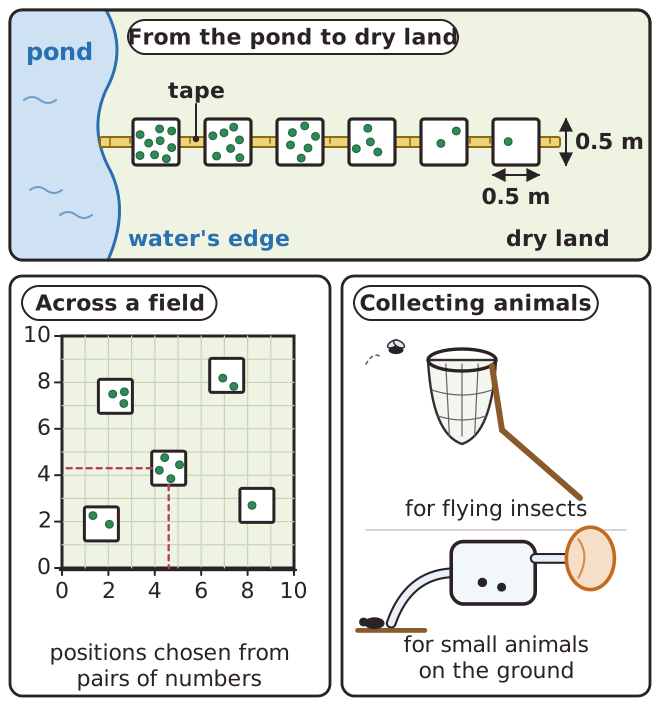
Ecologists cannot count every organism in a habitat, so they take samples. A quadrat is a square frame placed on the ground, and the organisms inside it are counted or the percentage cover is estimated. To avoid bias, a random sample is taken by choosing coordinates with random numbers and placing a quadrat at each position. Using more quadrats makes the estimate more reliable.
If the aim is to see how the distribution of a species changes across a habitat, for example from the edge of a pond to dry land, a transect is used. A tape is laid along the line and quadrats are placed at regular intervals along it. Small animals are collected with other equipment: a net sweeps flying insects out of the air or vegetation, and a pooter sucks small animals from the ground into a tube. A key is then used to identify each organism from its features.
To estimate the total number of a plant in a large area, scale up. Find the mean number per quadrat, then multiply by the total area of the habitat divided by the area of one quadrat. A field of 500 m2 sampled with 0.25 m2 quadrats holds 2000 quadrat areas. A mean of 3 daisies per quadrat gives 3 × 2000 = 6000 daisies.
Animals that move are estimated by capture-recapture. A sample is caught, marked and released. After time to mix, a second sample is caught. Population = (number in first sample × number in second sample) ÷ number of marked animals in the second sample. If 20 are marked, and a second sample of 30 has 5 marked, the population is 20 × 30 ÷ 5 = 120. This assumes the marks are not lost and the animals mix evenly.