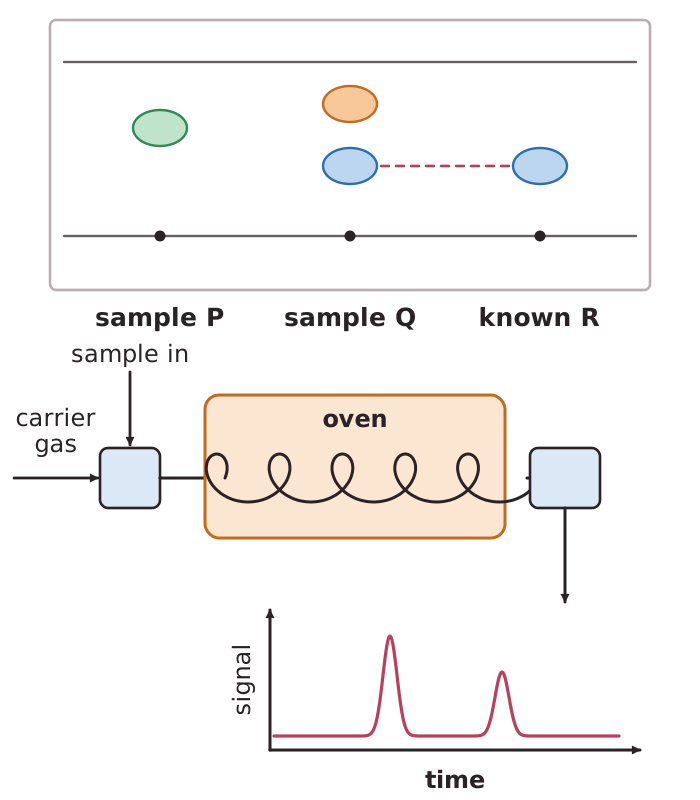
A chemically pure substance contains only one substance. Chromatography can be used to test this. In paper chromatography or thin layer chromatography (TLC), a pure substance gives only one spot. An impure substance, which is a mixture, gives more than one spot. If a sample is run next to known substances, spots at the same height as a known spot suggest that the known substance is present.
For example, a food colouring that is a single pure dye gives one spot. A food colouring made by mixing two dyes gives two spots. A black ink that separates into several coloured spots is a mixture.
Gas chromatography is used for mixtures of substances that can be turned into a gas. The sample is vaporised and a gas carries it through a long column. The column holds the stationary phase, and different substances take different times to travel through. The time each substance takes is its retention time. A detector at the end of the column records a peak for each substance that comes out.
A pure substance gives one peak. A mixture gives more than one peak. Gas chromatography is very sensitive, so it can detect tiny amounts of impurity that would be hard to see on paper, and the size of each peak shows how much of that substance is present.