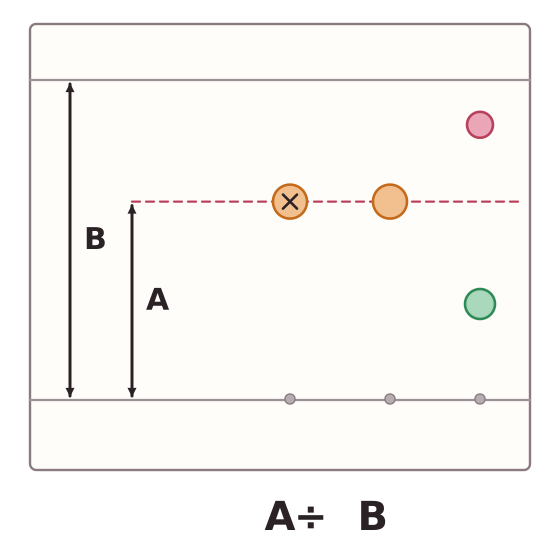
On a finished chromatogram, each spot shows a substance. To compare substances fairly you calculate the Rf value. Measure from the start line to the centre of the spot, and measure from the start line to the solvent front. Then use the formula:
Rf = distance moved by the substance ÷ distance moved by the solvent
For example, if a spot moves 3.0 cm and the solvent moves 7.5 cm, then Rf = 3.0 ÷ 7.5 = 0.4. Rf has no units because it is a ratio of two distances. It is always between 0 and 1, because a substance cannot travel further than the solvent. A spot that moves exactly half as far as the solvent has an Rf value of 0.5.
For a given substance, with the same solvent and stationary phase, the Rf value is always the same. So you can identify an unknown substance by comparing its Rf value with the values of known substances, or by seeing whether its spot lines up at the same height as a known spot run on the same plate. Spots at the same height with the same solvent are likely to be the same substance.
The number of spots in a column also tells you how many substances are in the sample.