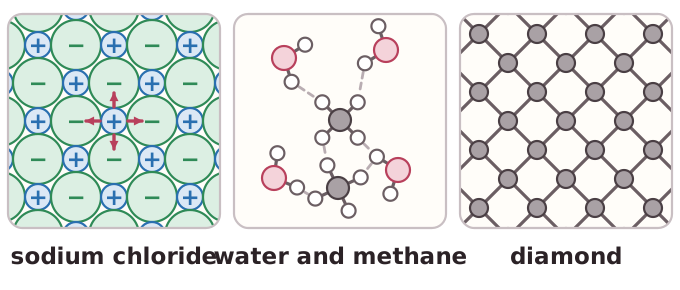
There are three main types of bonding structure in compounds. In an ionic compound, such as sodium chloride, a metal and a non-metal form oppositely charged ions. These are arranged in a giant lattice, a regular repeating pattern. Every ion is attracted to the oppositely charged ions around it, and these strong attractions act in all directions.
In simple molecules, such as water, carbon dioxide and methane, non-metal atoms are joined by covalent bonds into small separate molecules. The covalent bonds inside each molecule are strong. The forces between one molecule and the next, the intermolecular forces, are weak. Little energy is needed to overcome them, so simple molecular substances have low melting and boiling points.
In giant covalent structures, such as diamond and silicon dioxide, a huge number of atoms are joined by strong covalent bonds in one continuous lattice. There are no separate molecules. A lot of energy is needed to break so many bonds, so these substances have very high melting points. Ionic compounds also have high melting points.