The key equation is potential difference = current × resistance (V = IR). The unit of resistance is the ohm (Ω). Rearrange it to find current (I = V/R) or resistance (R = V/I).
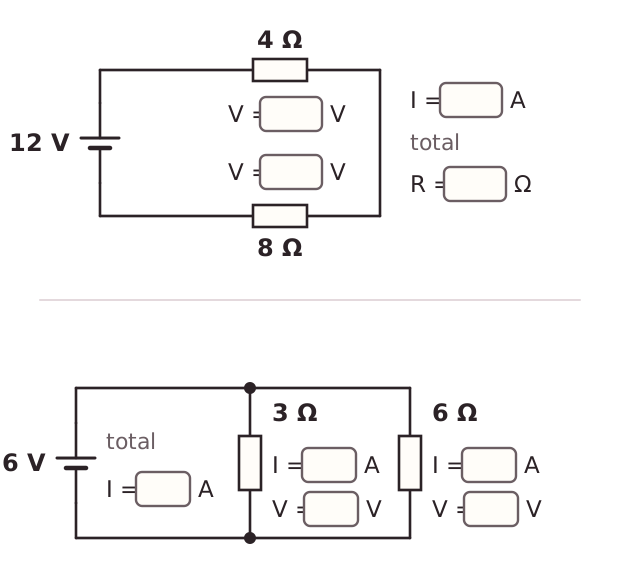
In a series circuit the current is the same everywhere. The potential differences across the components add up to the potential difference of the cell, and the total resistance is the sum of the resistances. For example, a 15 V cell with a 2 Ω and a 3 Ω resistor in series has a total resistance of 5 Ω and a current of 3 A. The potential differences are 6 V and 9 V.
In a parallel circuit the potential difference across each branch is the same as the cell. The total current is found by adding the branch currents. For example, a 12 V cell across a 4 Ω and a 6 Ω resistor in parallel gives 3 A in the 4 Ω branch and 2 A in the 6 Ω branch, so the total current is 5 A.
For a filament lamp, diode, thermistor or LDR the resistance is not fixed. Read the current and potential difference at the conditions you are given, or use the resistance stated for those conditions, and then use V = IR as normal.