These equations link the quantities in a d.c. circuit. Potential difference V (volts, V), current I (amperes, A), resistance R (ohms, Ω), charge Q (coulombs, C), power P (watts, W), energy E (joules, J) and time t (seconds, s) are related by:
- V = I × R
- Q = I × t
- P = V × I and P = I2 × R
- E = P × t and E = Q × V
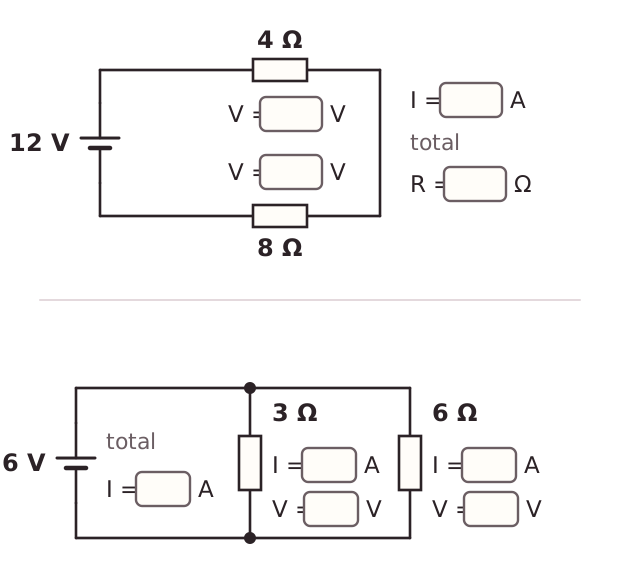
When resistors are connected in series there is only one path, so the same current flows through every resistor. The supply potential difference is shared between them. The equivalent resistance is the single resistance that would draw the same current from the supply, and for resistors in series it is found by adding the resistances: R = R1 + R2.
Worked example: a 12 V supply is connected to a 4 Ω resistor and an 8 Ω resistor in series. The equivalent resistance is 4 + 8 = 12 Ω. The current is I = V ÷ R = 12 ÷ 12 = 1 A, the same through both resistors. The potential difference across the 4 Ω resistor is 1 × 4 = 4 V and across the 8 Ω resistor is 1 × 8 = 8 V. These add up to the 12 V supply.
The same circuit transfers energy. In 60 s the charge that flows is 1 × 60 = 60 C. The power of the supply is 12 × 1 = 12 W, so the energy transferred in 60 s is 12 × 60 = 720 J.