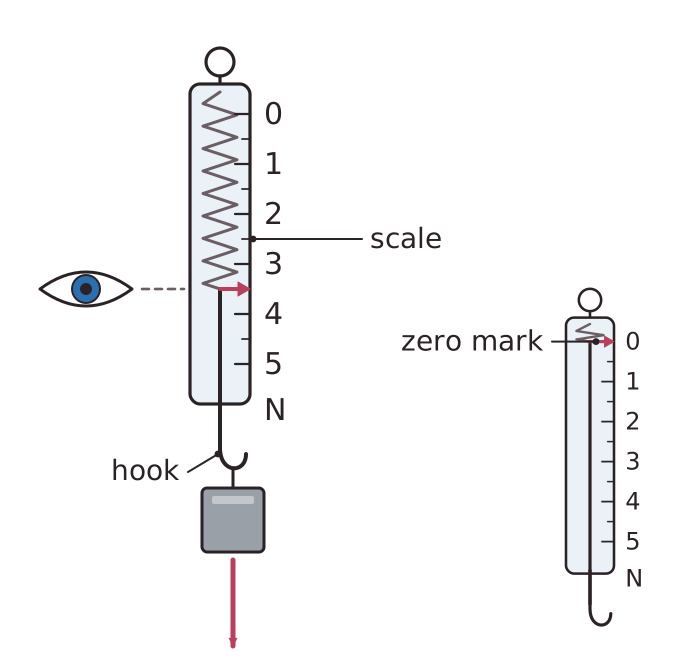
Weight is a force, so it is measured with a newtonmeter, also called a spring balance. A newtonmeter has a spring inside a case, with a hook at the bottom and a scale marked in newtons. To measure weight, hang the object from the hook and wait until it is still. The weight pulls the spring down and the pointer shows the reading on the scale in newtons.
The scale works because the extension of the spring is directly proportional to the force pulling on it. A bigger weight stretches the spring further, so the scale can be marked in newtons. Read the scale at eye level, and check that the pointer is at zero before the object is hung on it.
A balance that reads in kilograms measures mass, not weight. You can also work out weight from mass using weight = mass × gravitational field strength. Rearranging gives mass = weight ÷ gravitational field strength, or m = W ÷ g. If a newtonmeter reads 2 N and g is 10 N/kg, the mass is 2 ÷ 10 = 0.2 kg.