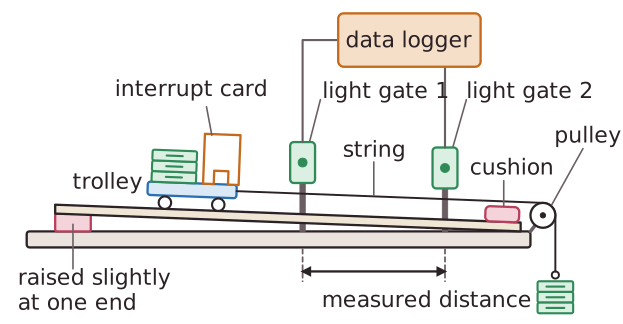
This practical tests Newton's second law, F = m × a. The aim is to keep the pulling force the same, change only the mass of the trolley, and see how the acceleration changes.
A trolley sits on a runway with a string running over a pulley to a hanging weight. The weight of the hanging masses is the pulling force, so it is kept the same for every run. The runway is tilted slightly so that friction is cancelled. Masses are added to the trolley one 100 g piece at a time. An interrupt card on the trolley passes through two light gates, which measure the speed at each gate and the time between them. Acceleration is the change in velocity divided by that time.
The independent variable is the mass of the trolley and the dependent variable is the acceleration. Control variables are the pulling force, the distance between the light gates and the slope of the runway. Repeat each run and take a mean to improve reliability.
The result is that more mass gives less acceleration, so the acceleration decreases as mass increases. Acceleration is inversely proportional to mass, so a graph of acceleration against 1/mass is a straight line through the origin. For safety, place a cushion or sand tray at the end of the runway to stop the trolley and keep feet clear of falling masses.