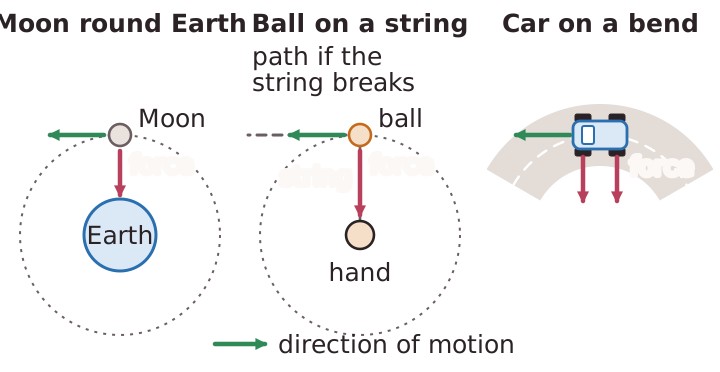
To move in a circle, an object needs a resultant force acting towards the centre of the circle. This is called the centripetal force. It is not a new kind of force. It is the name for whichever real force points towards the centre.
For a satellite or the Moon, the centripetal force is the gravity of the planet it orbits. For a ball whirled on a string, it is the tension in the string. For a car turning a corner, it is the friction between the tyres and the road. If the road is icy, friction becomes smaller and the car cannot turn, so it slides straight on.
The centripetal force acts at right angles to the velocity, so it changes the direction of the motion but not the speed. Without it, Newton's first law says the object would travel in a straight line. If the string on a whirled ball breaks, the ball flies off along the tangent because the centripetal force has gone.