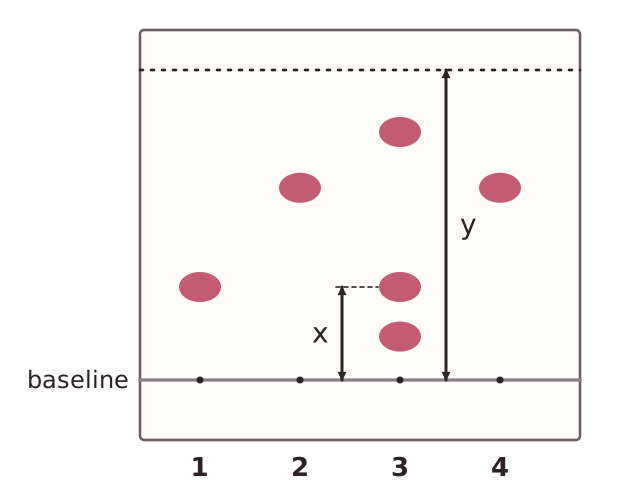
Paper chromatography separates a mixture of soluble substances. A pencil line, the baseline, is drawn near the bottom of the paper and a spot of each substance is placed on it. The paper (the stationary phase) is stood in a solvent (the mobile phase). The solvent moves up the paper, and each substance moves at a different rate.
Pure or impure. A pure substance gives a single spot. An impure substance, which is a mixture, gives more than one spot.
Identifying substances. Spots of known substances are run on the same paper in the same solvent. If a spot from the unknown sample travels the same distance as a known substance, it is probably that substance.
Rf values. Rf = distance moved by the substance ÷ distance moved by the solvent front. Both distances are measured from the baseline. An Rf value is always between 0 and 1 and has no units. For example, a spot that moves 3.0 cm while the solvent front moves 6.0 cm has an Rf of 0.5. The same substance has the same Rf in the same solvent.