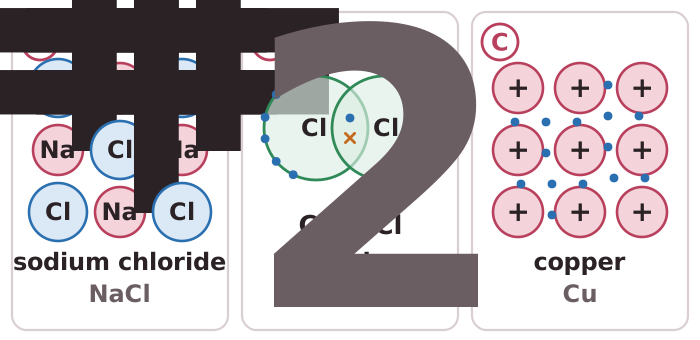
Atoms in a substance are held together by strong chemical bonds. There are three types: ionic, covalent and metallic. Each type depends on the particles involved and on what happens to the outer-shell electrons.
In ionic bonding the particles are oppositely charged ions. In covalent bonding the particles are atoms that share pairs of electrons. In metallic bonding the particles are atoms that share delocalised electrons.
The type of bonding depends on the elements. Ionic bonding occurs in compounds formed when a metal combines with a non-metal, such as sodium chloride. Covalent bonding occurs in most non-metallic elements, such as chlorine, and in compounds of non-metals, such as water. Metallic bonding occurs in metallic elements, such as copper, and in alloys.
All three types can be explained using electrostatic forces of attraction and the transfer or sharing of electrons.