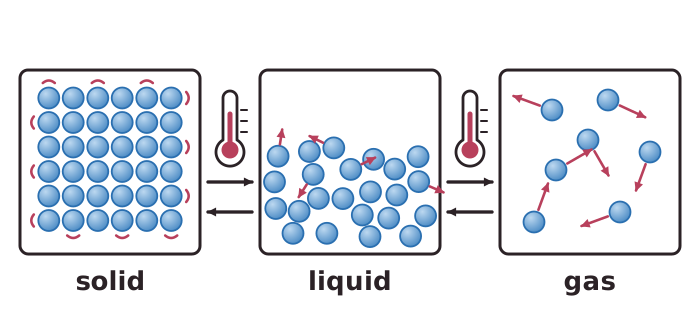
The three states of matter are solid, liquid and gas. Melting and freezing take place at the melting point. Boiling and condensing take place at the boiling point. A substance is a solid below its melting point, a liquid between its melting point and its boiling point, and a gas above its boiling point. So a substance that melts at 20 °C and boils at 150 °C is a liquid at 100 °C and a gas at 200 °C.
We use a simple model to show the states, with particles drawn as small solid spheres. In a solid the particles are close together in a regular pattern and only vibrate about fixed positions. In a liquid the particles are close together but arranged randomly, and they can move past each other. In a gas the particles are far apart and move quickly in random directions. This particle model helps to explain melting, boiling, freezing and condensing.
To melt a solid or boil a liquid, energy must be supplied to overcome the forces between the particles. The amount of energy needed depends on how strong those forces are, and that depends on the type of bonding and the structure of the substance. The stronger the forces between the particles, the higher the melting point and the boiling point, because more energy is needed to overcome them.
Atoms themselves do not have the bulk properties of a material. A single copper atom is not hard or shiny, and it does not have a melting point. These properties belong to a very large number of particles together.
Higher tier only: the simple model has limitations. It shows no forces between the particles, it shows every particle as a sphere, and it shows the spheres as solid.