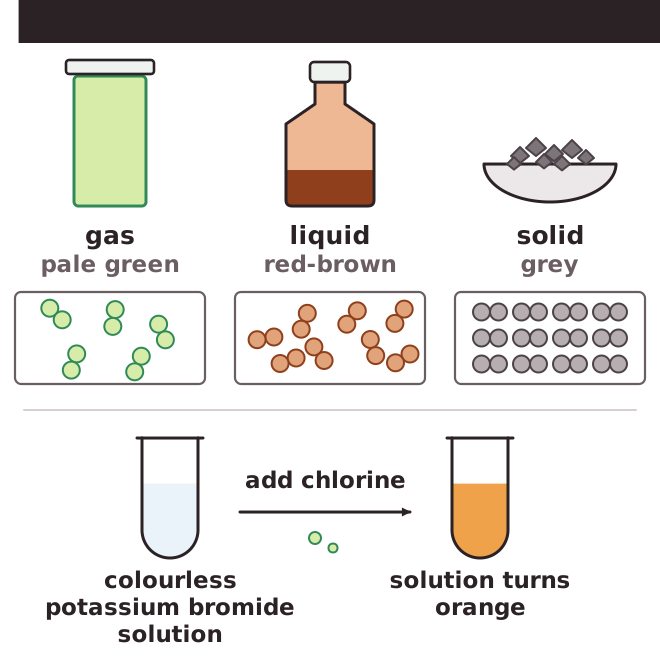
The elements in Group 7 are known as the halogens: fluorine, chlorine, bromine and iodine. They are non-metals, and each atom has seven electrons in its outer shell, which gives them similar reactions. Halogens exist as molecules made of pairs of atoms, such as Cl2, Br2 and I2.
Going down the group, the relative molecular mass, melting point and boiling point all increase. Chlorine is a pale green gas, bromine is a red-brown liquid and iodine is a grey solid at room temperature. The reactivity of the halogens decreases going down the group, because the outer shell is further from the nucleus, so it is harder for an atom to attract the extra electron it needs.
With metals, halogens form ionic compounds in which the halogen is a halide ion with a 1- charge, such as sodium chloride. With non-metals they form simple molecules held by covalent bonds, such as hydrogen chloride.
A more reactive halogen can displace a less reactive one from a solution of its salt. Chlorine added to potassium bromide solution gives potassium chloride and orange bromine: Cl2 + 2KBr → 2KCl + Br2. Bromine cannot displace chlorine, because it is less reactive.