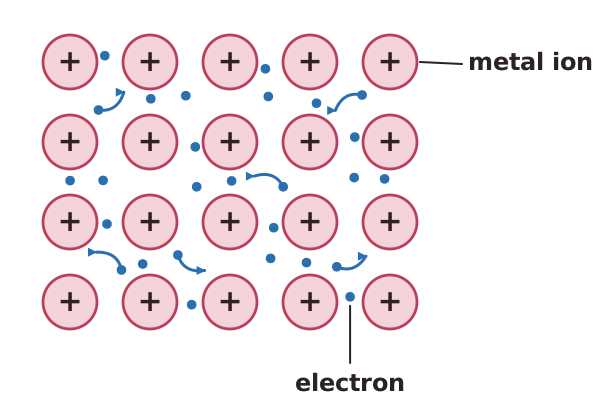
Metals consist of giant structures of atoms arranged in a regular pattern, usually in layers. The electrons in the outer shell of each metal atom are delocalised. This means they are not tied to one atom and are free to move through the whole structure.
The sharing of these delocalised electrons gives rise to strong metallic bonds. The atoms are held together by the attraction between the delocalised electrons and the positive metal ions (the atoms that lost them). Metallic bonding occurs in metallic elements and in alloys. Ionic bonding is different, because it needs a metal combined with a non-metal.
You can recognise a metallic giant structure from a diagram. It shows a regular pattern of identical atoms or ions, with delocalised electrons shown as small dots or a shaded region moving between them. Compare this with an ionic lattice, where positive and negative ions alternate and there are no free electrons, and with a covalent structure, where atoms are joined by shared pairs of electrons.