Atoms are very small. An atom has a radius of about 0.1 nm, which is 1 × 10⁻¹⁰ m. The nucleus is much smaller still: its radius is less than 1/10 000 of the radius of the atom, about 1 × 10-14 m. Almost all of the mass of an atom is in the nucleus, because protons and neutrons are far heavier than electrons.
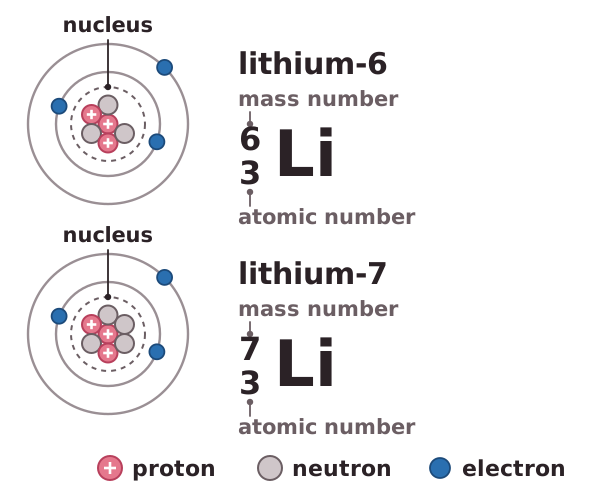
The relative masses are: proton 1, neutron 1 and electron very small. The sum of the protons and neutrons in an atom is its mass number. Number of neutrons = mass number − atomic number. Sodium has mass number 23 and atomic number 11, so it has 11 protons, 11 electrons and 12 neutrons. For an ion, the electrons are different: a Na+ ion has lost one electron, so it has 10 electrons.
Atoms of the same element can have different numbers of neutrons. These atoms are called isotopes of that element. They have the same atomic number but different mass numbers. Chlorine-35 has 18 neutrons and chlorine-37 has 20 neutrons, but both have 17 protons.