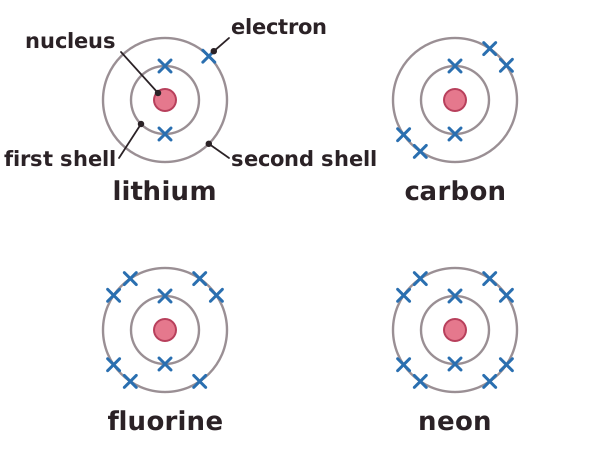
The electrons in an atom are arranged in shells, which are also called energy levels. Electrons always occupy the lowest available energy levels first, so the innermost shell, the one closest to the nucleus, fills before the next shell starts to fill.
Each shell can only hold a certain number of electrons. For the first twenty elements, the first shell holds a maximum of two electrons and the second shell holds a maximum of eight. The third shell also holds eight before the fourth shell begins to fill. A neutral atom has the same number of electrons as protons, so the number of electrons is the atomic number.
The electronic structure of an atom can be written as numbers, one for each shell, starting with the innermost. Sodium has atomic number eleven, so it has eleven electrons: two in the first shell, eight in the second and one in the third. Its electronic structure is 2,8,1. Chlorine has atomic number seventeen, so it has seventeen electrons and its electronic structure is 2,8,7. Magnesium has atomic number twelve, so it has twelve electrons and its structure is 2,8,2. Potassium has nineteen electrons, so after 2,8,8 the last electron goes into the fourth shell, giving 2,8,8,1.
The same structure can also be shown in a diagram of the shells, but the numbers carry exactly the same information. The electrons in the outer shell decide how an element behaves, and the number of outer electrons matches the group of the element in the periodic table.