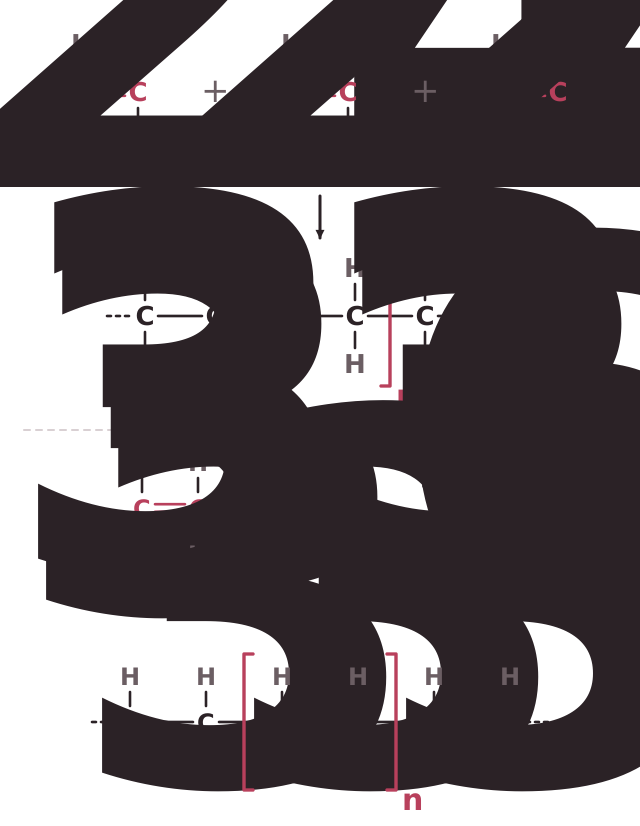
An addition polymer is made when many small alkene molecules, called monomers, join together in one long chain. Each monomer has a C=C double bond. In the reaction the double bond opens up and each molecule joins on to the next. Nothing else is made, so the polymer is the only product.
Ethene, C2H4, makes poly(ethene). Propene, C3H6, makes poly(propene). We show a polymer by writing its repeat unit in brackets with a small n outside, where n is a very large number. For poly(ethene) the repeat unit is [CH2CH2]n. The repeat unit has the same atoms as the monomer, but the two carbon atoms are joined by a single bond instead of a double bond.
To deduce the polymer from a monomer, change the double bond to a single bond and put the repeat unit in brackets with n outside. To deduce the monomer from a polymer, take one repeat unit and put the C=C double bond back between the two carbon atoms in the chain. The repeat unit of poly(propene) is [CH2CH(CH3)]n, so its monomer is propene.